

Difficult to treat conditions made easier.
What is Deep Brain Stimulation (DBS)?
What sets the Medtronic Percept™ system apart from competing DBS platforms is BrainSense™ Technology. Unlike other DBS systems, BrainSense™ allows clinicians to observe a patient's brain activity at the exact moment symptoms occur — including outside of office visits — enabling more precise, adaptive, and personalized therapy over time. Note that signal may not be present or measurable in all patients, and the clinical benefits of brain sensing have not been fully established (Medtronic, 2023).
The Percept™ family offers two device options:
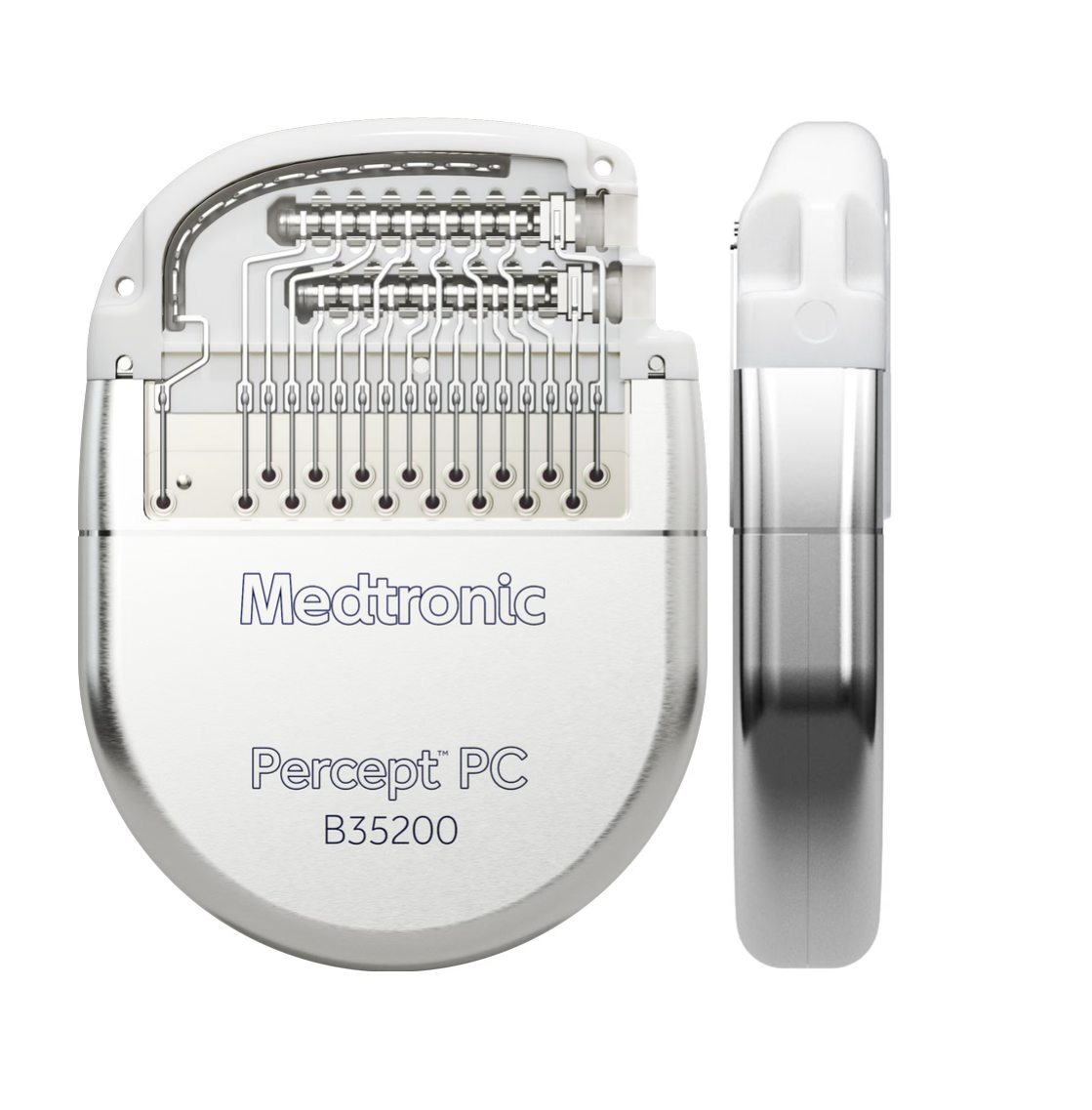
- Percept™ PC — Recharge-free, with a projected battery life of more than 5 years. The thinnest recharge-free DBS device currently on the market.
- Percept™ RC — Rechargeable, designed for at least 15 years of service life. The smallest and thinnest rechargeable DBS device available. Charges from 10% to 90% in under one hour. Both devices are engineered to receive future software updates — adding new features and programming capabilities — without requiring replacement surgery. This is a meaningful advantage over competing systems that do not offer the same upgrade pathway (Medtronic, 2023).
Deep Brain Stimulation (DBS) is a surgical therapy that delivers precise, mild electrical impulses to targeted regions of the brain through implanted electrodes. It functions similarly to a cardiac pacemaker — but for the brain. The gold standard device is the Medtronic Percept™ neurostimulator, the world's most widely implanted DBS system, featuring exclusive BrainSense™ Technology that records real-time brain signals during ongoing therapy. Medtronic has helped more than 180,000 people with DBS over more than 30 years (Medtronic, 2023).
Brain imaging is used to identify the specific neural circuit driving a patient's symptoms. A neurosurgeon implants one or two thin electrode leads into that target region. These leads connect via flexible SenSight™ extensions to the Percept™ neurostimulator — a small device placed beneath the skin near the collarbone — which continuously delivers calibrated electrical signals to the brain.
60%
response rate
for patients with OCD
5
more days symptom free
for patients with Parkinson’s Disease
95%
of patients recommend DBS
to their friends and family

Unmatched results in the most difficult to treat diseases.
Clinical data show that Parkinson's patients with longer-standing motor complications experienced 5 additional hours per day of "on" time without troublesome dyskinesia compared to medication management alone (Medtronic Clinical Summary, n.d.). Activities of daily living also improved significantly for patients with Essential Tremor receiving DBS (Medtronic Clinical Summary, n.d.). In a long-term follow-up study, 95% of Parkinson's patients who received DBS reported they would recommend the therapy to friends and family.
Hitti et al., 2019
What conditions does DBS treat for?
Medtronic DBS is FDA-recognized across five indications. At Brighter Neurotherapeutics, the primary focus is psychiatric neuromodulation: Treatment-Resistant Depression (investigational) and Obsessive-Compulsive Disorder (FDA-approved under HDE). DBS for Parkinson's Disease carries full FDA approval and represents the most extensively studied application of this therapy.
Regulatory status varies significantly by indication. Treatment-Resistant Depression is investigational — available only through clinical trials. OCD carries FDA authorization under a Humanitarian Device Exemption. Parkinson's Disease, Essential Tremor, and Epilepsy have full FDA approval. Understanding this distinction is essential for informed consent and insurance planning.
-
DBS targets the subcallosal cingulate region (Area 25). Available through the Mount Sinai single-center study and the multi-center TRANSCEND trial, which holds FDA Breakthrough Device designation.
*Not yet commercially approved. Available only through IRB-approved clinical trial participation (Mount Sinai, n.d.). Patients do not pay for investigational treatment but must meet strict eligibility criteria and consent to study participation. Mount Sinai's TRANSCEND trial holds FDA Breakthrough Device designation, reflecting the FDA's recognition that this therapy may offer a substantial improvement over existing options for a serious condition (Mount Sinai, n.d.).
-
FDA-approved under a Humanitarian Device Exemption (HDE). DBS is indicated for chronic, severe, treatment-resistant OCD in adults who have failed at least three SSRIs. The stimulation target is the anterior limb of the internal capsule (AIC). Covered by Medicare, Medicaid, and most commercial insurers (Mount Sinai, n.d.).
-
Full FDA approval. Bilateral stimulation of the subthalamic nucleus (STN) or internal globus pallidus (GPi). Indicated for levodopa-responsive PD of ≥4 years' duration with motor symptoms — including tremor, slowed movement, stiffness, and dyskinesia — not adequately controlled by medication. Both recent-onset (4 months to 3 years) and longer-standing motor complications are covered indications (Medtronic, 2023).
-
Full FDA approval. Unilateral thalamic stimulation of the ventral intermediate nucleus (VIM) to suppress disabling arm tremor not controlled by medication. Note: indicated for single (unilateral) lead placement only (Medtronic, 2023).
-
FDA-approved under a Humanitarian Device Exemption (HDE). Indicated for chronic, intractable primary dystonia — including generalized, segmental, hemidystonia, and cervical dystonia — in patients aged 7 and older. The effectiveness of this device for the treatment of dystonia has not been fully demonstrated (Medtronic, 2023).
-
Full FDA approval. Bilateral stimulation of the anterior nucleus of the thalamus (ANT) as adjunctive therapy for partial-onset seizures in adults ≥18 years, refractory to three or more antiepileptic medications, averaging six or more seizures per month (Medtronic, 2023).
Transformative outcomes, using the power of frequency.
Here’s what to expect.
01 — Getting Started
See if DBS is right for you by giving us a call. Completely complimentary and without obligation, we will review your medical history and go over treatment expectations, logistics, and possible insurance coverage, together. If you decide to move forward, simply complete our new patient registration form here onsite and a member of our team will give you a call to come in for a clinical consultation.
02 — Clinical Consultation
Our team will work with you to schedule your initial Psychiatric Evaluation and Consultation with Dr Grant Brenner MD DFAPA along with your referring physician. Here, Dr Brenner completes an in-depth review of your medical and psychiatric history and provides a comprehensive clinical evaluation. For Treatment-Resistant-Depression, we conduct a detailed review of your complete antidepressant treatment history. For OCD, we request to review the documentation of all prior medication and therapy trials. Together, you discuss your treatment goals and address any questions you may have. If both you and Dr Brenner agree that DBS is right for you, we will submit your case for a formal DBS evaluation and approval from a multidisciplinary team of specialists.
Step 3 — Multidisciplinary Eligibility Review
A team of specialists — including psychiatry, neurology, and neurosurgery — reviews your case. For TRD, you are screened against the clinical trial's inclusion and exclusion criteria. For OCD, the team confirms that all required medication and therapy trials have been completed. Structured psychological assessments are typically conducted at this stage.
Step 4 — Neuroimaging & Surgical Planning
High-resolution MRI and other brain scans are used to precisely identify the stimulation target. For TRD, this is the subcallosal cingulate (Area 25). For OCD, it is the anterior limb of the internal capsule (AIC). For Parkinson's disease, targets include the STN or GPi. Medtronic's SureTune™ 4 software may be used to visualize the Volume of Neuronal Activation relative to patient anatomy (Medtronic, 2023).
Step 5 — Surgical Implantation
Under anesthesia, a neurosurgeon implants the Medtronic SenSight™ directional electrode leads into the target brain region and places the Percept™ PC or Percept™ RC neurostimulator beneath the skin near the collarbone. Flexible SenSight™ extensions — approximately 26.7% smaller in diameter and 64% easier to flex than prior-generation extensions — connect the leads to the device. The procedure typically requires a brief hospital stay (Medtronic, 2023).
Step 6 — Activation & Initial Programming
Following recovery, your clinical team activates the Percept™ neurostimulator and calibrates the initial stimulation parameters. BrainSense™ Technology begins recording real-time brain signals, helping guide optimal programming decisions from the outset. Many patients notice early symptom relief at this stage (Medtronic, 2023).
Step 7 — Ongoing Monitoring & Adaptation
Regular follow-up visits allow your clinician to review BrainSense™ data, observe patterns in your brain signals over time, and refine stimulation settings as your needs evolve. The Percept™ patient programmer — a simple handheld device — allows you to check battery life, log symptoms in a digital diary, enable MRI mode, and adjust stimulation within the limits your clinician has prescribed.
Step 8 — Long-Term Management
Over time, many DBS patients are able to reduce their reliance on psychiatric or neurological medications, decreasing medication-related side effects. Because the Percept™ platform is engineered for software upgrades, new clinical features and programming capabilities can be added to your existing implanted device without replacement surgery — keeping your therapy current as the science advances (Medtronic, 2023).


We track progress and treatment success using MRI-guided approaches.
We utilize cutting edge fMRI imaging to establish your unique neurologic foundation, allowing us the ability to assess and monitor measurable results throughout the course of treatment. fMRI has been proven safe and effective in providing ongoing measurement of the neurological shifts made by your aTMS therapy and allows us to adapt your treatment to address your specific response to therapy, alleviate any immediate neurologic issues, and ensure real, transformative, and optimal results.
For MRI-guided treatment planning and care, Dr Brenner partners with Dr Mark Allen PhD, a leading neuroscientist and cofounder of Cognitive FX, to determine what type of brain imaging would be most helpful and the best approach to measure and evaluate progress throughout your treatment.
-
MRI-guided treatment is especially helpful if you're dealing with complex mental health challenges that go beyond typical depression or OCD, or if you've tried standard treatments before without the results you were hoping for. Some people have unique brain anatomy that requires a more individualized approach to treatment. MRI brain imaging gives us detailed information that helps us move beyond one-size-fits-all protocols to create a treatment plan designed specifically for you.
-
An MRI (magnetic resonance imaging) scan is a painless 30-minute scan that produces very clear images of the brain. MRI uses a large magnet and radio waves to produce detailed images. There are two main types of MRI scans that we might use: sMRI (structural) and fMRI (functional). sMRI shows us the detailed anatomy of your brain to help us target the right areas, while fMRI shows us how different parts of your brain communicate with each other. This functional imaging helps us understand your brain's network patterns, which allows us to choose both the best treatment locations and the most effective treatment approach.

We partner with the leaders in technology and innovation.
What sets the Medtronic Percept™ system apart from competing DBS platforms is BrainSense™ Technology. Unlike other DBS systems, BrainSense™ allows clinicians to observe a patient's brain activity at the exact moment symptoms occur — including outside of office visits — enabling more precise, adaptive, and personalized therapy over time. Note that signal may not be present or measurable in all patients, and the clinical benefits of brain sensing have not been fully established (Medtronic, 2023).
Utilizing these cutting edge innovations helps us to ensure that we are successfully targeting the exact neurologic positions necessary, for every pulse, in every session, throughout the course of treatment.
-
The Percept™ family offers two device options:
Percept™ PC — Recharge-free, with a projected battery life of more than 5 years. The thinnest recharge-free DBS device currently on the market.
Percept™ RC** — Rechargeable, designed for at least 15 years of service life. The smallest and thinnest rechargeable DBS device available. Charges from 10% to 90% in under one hour. Both devices are engineered to receive future software updates — adding new features and programming capabilities — without requiring replacement surgery. This is a meaningful advantage over competing systems that do not offer the same upgrade pathway (Medtronic, 2023).
-
DBS for Treatment-Resistant Depression is currently investigational and available only through clinical trials. The following criteria apply to the Mount Sinai single-center study and the multi-center TRANSCEND trial (Mount Sinai, n.d.):
Inclusion criteria:
- Non-psychotic unipolar Major Depressive Disorder lasting ≥12 months, or at least 3 lifetime depressive episodes
- Failed ≥4 different antidepressant treatment types
Exclusion criteria (partial list):
- Pregnancy
- Current or lifetime history of psychotic features in any Major Depressive Episode
- Active Substance Use Disorder or Alcohol Use Disorder without sustained remission of 12 months or longer
- Significant acute suicide risk
- Comorbid medical or psychiatric conditions that would limit study participation or adherence
- Intracranial CNS disease impairing motor, sensory, or cognitive function
- Current use of neurostimulation that may interfere with DBS therapy
- Concurrent enrollment in another investigational device or drug study